Educational Philosophy

Education is a social process. Education is growth. Education is not a preparation for life; education is life itself.

~ John Dewey

Our simple educational philosphy: we learn as we live and we celebrate what we learn!

Learning Through Living - Blogged


Recent Reads

Showing posts with label unplugyourkids. Show all posts

Monday, January 12, 2009

Scales -- Think!


For Think! this week, the girls made a scale. You can read about it here.

Conveniently, this scale project also fits with this week's unplugged theme: balance.

Monday, November 17, 2008

Sort/Junk/Donate Unplug Your Kids

We are still in the processing of sorting through all of our Christmas junk. Once it is all sorted, we'll decide what is actually junk and what we'd like to donate. We found some cool wooden balls in a Christmas basket. They are about 2 inches in diameter and they are flat on one side. The pic turned out fuzzy, so no pic. Any suggestions on what to do with them?

Saturday, November 08, 2008

Flags, Kitchen and Unplug Your Kids


After a brief break from Unplug Your Kids, we found time this week to knock out two categories of Unplug Your Kids: last week was flags and this week is kitchen. So, to celebrate change, we made flag cupcakes in the kitchen(the girls' cousins helped decorate). I know it's not much. But, at least we participated this week!

Sunday, October 12, 2008

Smooth -- Unplug Your Kids

This week we learned about smooth jazz as our unplug your kids project. First, we read about the history of jazz here. We learned that smooth jazz evolved from Fusion and that it usually does not include improvisation. Instruments include electric keyboards, sax, guitar, and percussion and it is probably the most commercial form of jazz. Next, we listened to smooth jazz by Kenny G, Chuck Mangione, Richard Elliott, Boney James, Rick Braun, David Benoit, Bob James, Paul Hardcastle, David Sanborn, George Benson, Norman Brown and others here. We learned a bit more about Chuck Mangione here. Then, we created some artwork to go with Mangione's work, "Land of Make-Believe."

Saturday, October 04, 2008

Unplug Your Kids - White

This week, we focused on black and WHITE photography for the theme white. We took some pictures:


And, we studied two black and white photographers: Minor WHITE and Helen Levitt.


Minor White

Minor White

Minor White
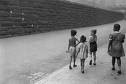
Helen Levitt

Helen Levitt

Helen Levitt

Here's what we learned:

Minor Martin White was an American photographer born in 1908 in Minneapolis, Minnesota. He earned a degree in Botany with a minor in English from the University of Minnesota in 1933 and began his working career as a poet. In 1938, White moved to Portland, Oregon where he began his career in photography. He was a member of the Oregon Camera Club and he also worked for the Works Progress Administration. He taught classes at the YMCA and exhibited work at the Portland Art Museum.

After serving during World War II, White moved to New York City in 1945. He spent two years studying aesthetics and art history at Columbia University. During that time, he got to know several influential photographers including Alfred Stieglitz,Edward Weston, and Ansel Adams. He photographed things usually considered mundane, making them special by the way they were photographed. One of his more popular photographs is titled Frost on Window, a close-up of frost crystals on glass. White moved to the West Coast to join the faculty of the California School of Fine Arts in San Francisco in 1946. He worked there until 1953 when the school enrollment began to decline. This part of his life was covered in the 2006 book: The Moment of Seeing: Minor White at the California School of Fine Arts. White's first major exhibition was in 1948 at the San Francisco Museum of Art. He co-founded the magazine Aperture in 1952. He edited the magazine until 1975. He worked as a curator at George Eastman House and edited their magazine Image. He taught at the Rochester Institute of Technology from 1956 to 1964. He also taught at MIT for 10 years before he died in 1976. He is most known for his ideas about the spiritual self and photography.

Helen Levitt was born in 1913 in Brooklyn, New York. She is known as a "street photographer" around New York City, and has been called "the most celebrated and least known photographer of her time." After dropping out of high school, she taught herself photography. Her first well-known photographs are those of children in 1937 drawing with chalk. She worked with photographer Walker Evans in 1938 and 1939 and she had her first solo exhibition "Helen Levitt: Photographs of Children" at the Museum of Modern Art. In the late 1940s, Levitt made documentary films with Janice Loeb and James Agee. She received an Academy Award nomination for the screenplay of The Quiet One. Levitt remained active in filmmaking for nearly 25 years. In 1959 and 1960, Levitt received two Guggenheim Foundation grants to take color photographs on the streets of New York, and she returned to still photography. In 1976, she was a Photography Fellow of the National Endowment for the Arts. Although she has not taken photos since the early 1980s, she is still living in New York.

Monday, September 22, 2008

Unplugged -- Hard

Last week's theme for Unplug Your Kids was "hard" so we found a bit of time to learn about Hard Edge Painting. We explored the works of Al Held, Ellsworth Keelly, Alexander Liberman, Brice Marden, and Kenneth Noland. Then, we created our own Hard Edge pieces:

Thursday, September 11, 2008

Soft -- Kids Unplugged

It took us a while to have time for this project at UnplugYourKids, but we made fleece hats (yes, it is still hot here, but we love these hats and you can't have too many of them!). The girls use them for swimming. First, you cut a piece of fleece 18 x 20 inches.


Fold up 1-2 inches on the 18 inch side and sew seam.


Place right sides together


and sew seam from hemmed side up 10-11 inches. You should have a long cylindrical sewn piece.


Cut the fleece in strips from the open end to the top of the hemmed side (these will be your "bun").


Turn it inside out. Take two strips and wrap them around the others and then tie them together.


Voila! You have a soft warm hat.

Sand -- Unplug Your Kids Again

This week for the unplugged project, we were slow on our soft project and we'll post it shortly, but we're ahead on our sand project. We got this idea from Toad Haven.

We can't seem to link to our creation but here is a picture of the printed version -- it is number 22337 in the gallery.


Go to thisissand.com. Make your own picture!

I know this isn't entirely an unplugged project since computers are plugged in, but the good news is we are getting a solar battery charger for laptop for Christmas! And, then the computer can be considered unplugged!

Tuesday, August 26, 2008

Unplugged -- Insect

This weeks unplugyourkids theme was insects. The girls are teaching a collage class for elementary students later this month so we thought we'd try collaging some insects -- here are two samples of the collages that the girls will use when they teach.


And here are some other samples they'll use.


P.S. We were able to use some of the materials from the Free Time Kit that we got from Shawn in one of her giveaways. By the way, the kit was awesome!

Monday, August 25, 2008

Unplug Your Kids Again


Again, we are probably the oldest participants other than supervising parents, but we tried to do something this past week that fit the unplugyourkids challenge. The theme was cylinder. And, this is what we did -- we painted cylinders and worked on shadowing. If you want to try this at home, check out this tutorial.

Tuesday, August 12, 2008

Unplug Your Kids -- Hot

We joined the unplugyourkids project again this week. And, here is what we came up with:

For this week’s theme, we made a list of sayings using the word hot and then figured out their origins:


1. Piping Hot (very hot, usually referring to food because in Scotland ceremonial dishes are brought to the table to the accompaniment of bagpipes – they are piped in )

2. Hot off the press (freshly printed – hotness is an allusion to the hot metal press used to print newspapers)

3. Hot on the heels (hunter’s terminology for getting close to the hunted – on the heels because they are close and hot because the creature being hunted is warm-blooded)

4. Hot pursuit (same)

5. Hot bunking (comes from the notion that there aren’t enough bunks on a ship so when one sailor gets up another lies down before the warmth dissipates)

6. Hot crossed buns (on Easter an ox was sacrificed and the image of his horns was carved on bread)

7. Hot button (hot button came from marketing )

8. Hot little hands (comes from Elizabeth Gaskell’s 1863 popular novel)

9. Sell like hot cakes (hot cakes were popular in early Ameican /made from cornmeal they were best when served hot and sold quickly then)

Most of the origin information we found came from http://www.phrases.org.uk

If you can think of hot phrases and know their origins, leave a comment!

Wednesday, August 06, 2008

Rough

Today we tried the unplug your kids project. Here is the result: . If you want to make your own mosaic go to bighugelabs. It's easy and fun!

National Geographic Place of the Week