
We just got our first free early release book from LibararyThing here's the review:
The Secret Holocaust Diaries
Reviewed by t
The Untold Story of Nonna Bannister is a great book about the hardships of a young girl in Russia during World War II. The book begins with Nonna telling the story about her childhood days. Her family was well off until the Germans invaded. And, then her family got separated, forcing Nonna and her mother, Anna, to do whatever it took to survive. What is amazing about this story is that Nonna kept this story of her past tucked away for many years. She did not tell her husband or the rest of her new family about her horrors of the Holocaust until she was quite old. This story was well written, however it was confusing. The author wrote about the historical aspects of Nonna’s story. This was a good idea, to relate her recollections of events to what happened; however, it made it more difficult for the reader to connect with Nonna’s character. Just as the story was getting interesting, the author inserted historical information. Despite this, the story was interesting and I would recommend it to Holocaust buffs and all those who want to see a different perspective on the Holocaust.
Educational Philosophy
Education is a social process. Education is growth. Education is not a preparation for life; education is life itself.
~ John Dewey
Our simple educational philosphy: we learn as we live and we celebrate what we learn!
Showing posts with label language arts. Show all posts
Showing posts with label language arts. Show all posts
Saturday, April 11, 2009


Saturday, March 14, 2009
To Kill a Mockingbird
Saturday, February 07, 2009
Published!
By email yesterday:
"Congratulations! Your recent submission to Teen Ink has been posted on Teen Ink RAW, our new website of unedited and unfiltered teen-generated poetry, fiction, articles, reviews, opinions, artwork, etc. Teen Ink RAW allows you and others to rate work, provide feedback, and share stories with friends and family.
On the new Teen Ink RAW site, the highest-rated stories in each section will be prominently displayed on the home page and elsewhere. Your work could be among them, so vote often and send the link to your friends and family and ask them to vote too. (Up to one vote per article per day.)
Here is a link to your article( H's): http://www.teenink.com/raw/Nonfiction/article/81754/Memories-to-Last-a-Lifetime/
And here is another link to T's: http://www.teenink.com/raw/Nonfiction/article/81755/America-Is-Beautiful/
If you have time, please read the articles! The more 5s the girls get, the higher it will appear on the web page.
"Congratulations! Your recent submission to Teen Ink has been posted on Teen Ink RAW, our new website of unedited and unfiltered teen-generated poetry, fiction, articles, reviews, opinions, artwork, etc. Teen Ink RAW allows you and others to rate work, provide feedback, and share stories with friends and family.
On the new Teen Ink RAW site, the highest-rated stories in each section will be prominently displayed on the home page and elsewhere. Your work could be among them, so vote often and send the link to your friends and family and ask them to vote too. (Up to one vote per article per day.)
Here is a link to your article( H's): http://www.teenink.com/raw/Nonfiction/article/81754/Memories-to-Last-a-Lifetime/
And here is another link to T's: http://www.teenink.com/raw/Nonfiction/article/81755/America-Is-Beautiful/
If you have time, please read the articles! The more 5s the girls get, the higher it will appear on the web page.
Thursday, December 11, 2008
Childrens Books on Religion
The girls each wrote a book for children on a religion. This is T's. I hope to upload H's soon.
Friday, November 14, 2008
Identifying Types of Imagery


The girls made these posters identifying different types of imagery in The Cask of Amontillado.
Saturday, November 01, 2008


Tuesday, October 21, 2008


Sunday, October 05, 2008


Wednesday, September 24, 2008
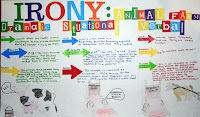
English -- Irony in Animal Farm
The girls made these "posters" outlining the 3 types of irony in Animal Farm.



Tuesday, September 09, 2008
Peace Essays

The girls each wrote an essay on how we can create a Culture of Peace. They tried to enter it in a local essay contest but it turned out it was only for seniors in high school. Anyway, the essays were good enough that I thought I would publish them here:
T:
A few years ago, I read We Are All the Same by Jim Wooten. It is a story about Nkosi Johnson, a boy living with AIDS in South Africa. Speaking to an international AIDS conference shortly before his death, Nkosi said, “We are all the same.” He was right. If we want to create a culture of peace, we must learn to embrace this idea of sameness while celebrating the diversity of cultures, nations, and religions. First, we must learn to care about other cultures and religions in the far corners of the world. In understanding others, we will realize that we are all the same. Second, we must learn how to resolve conflicts by looking for common interests rather than finding differences. Finally, we must ensure equality of opportunity around the world because until there are opportunities for all people to live, learn and prosper, we will be burdened with the consequences of inequality such as starvation, illness, and environmental decline.
In 2006, National Geographic found that only 37% of young Americans could find Iraq on a map; 6 in 10 young Americans couldn’t speak a foreign language fluently; 20% of young Americans thought Sudan was in Asia; and, 48% of young Americans believe the majority population in India was Muslim. I am a young American. How can I help promote peace in Iraq if I don’t understand the culture and needs of the people who live there? How can I help find resolutions to religious disagreements if I don’t understand the religions involved? How can I find solutions to environmental problems in undeveloped countries if I don’t understand the environment and people of those countries? We are all human. We all have basic human rights. If we want to advance those rights around the world, we must understand each other’s differences and then we can celebrate that, in the end, we are all the same.
According to a report by the National Youth Violence Prevention Resource Center, a 2001 national survey of high school students found that 33% of the students had been in a physical fight and 4% of the students had been hurt badly enough to need medical treatment. How can we expect these same students to grow up and negotiate international peace treaties or international business transactions? We must teach conflict resolution from toddlerhood so that Americans are better prepared for conflicts that arise in their homes, neighborhoods, schools, and country. With a better understanding of how to find common goals rather than highlight differences, students can learn to build a peaceful world free of violence and misunderstanding.
Jimmy Carter noted in his Nobel Prize acceptance speech in 2002, “Citizens of the ten wealthiest countries are now seventy-five times richer than those who live in the ten poorest ones, and the separation is increasing every year, not only between nations but also within them. The results of this disparity are root causes of most of the world's unresolved problems, including starvation, illiteracy, environmental degradation, violent conflict, and unnecessary illnesses that range from Guinea worm to HIV/AIDS.” We must look beyond our shores to help solve world hunger. In doing so, we are taking a long step toward reducing the problems that are at the root of world conflict.
If we want to create a culture of peace, we must accept that the human condition is shared among all. For the sake of peace, we must learn more about all cultures and religions and conflict resolution and we must work hard to ensure equality of opportunity. The first step is to eliminate world poverty.
H:
Martin Luther King Jr. wisely said, “True peace is not the absence of tension but the presence of Justice.” In order to build a culture of peace, we must not only eliminate injustices such as poverty and violence, but we must make peace present in our everyday lives by teaching it in our schools and our faith groups.
The US Census Bureau counted 35.9 million people below the poverty line in America, including 12.9 million children. That means 12.9 million children not getting enough food to eat. That means 12.9 million children in America hungry when they open their eyes. The FBI reported 1.41 million violent crimes in 2006, an increase of 1.9 % since 2005. And, the Department of Justice says about 35% of American households own 192 million firearms, and about 67.2 million of those are handguns. These statistics are alarming. Imagine a world where we eliminated poverty and crime. Imagine a world where no one felt the need for guns. Imagine a world where there were not guns in the home. Imagine a world where children had food on the table and adults trusted each other. That would be a world full of peace.
According to the National Center for Education Statistics, 13% of American students reported being threatened or hurt with a weapon at school. We must make peace present in our schools. We must make our schools and streets safe. According to the US Census Bureau, there are approximately 55 million students in grades K-12 in the United States. Imagine a world where all of those students learned about mediation, negotiation and other forms of conflict resolution. Imagine the presence that peace would have then. Imagine adults who have been taught conflict resolution since childhood, becoming military generals or international diplomats. What would our world look like then? That world would be full of peace.
According to the Hartford Institute there are roughly 335,000 religious congregations in the United States and about 56 million worshippers. That means about 20% of the U.S. population is connected to a religious group. Imagine a culture where everyone embraced peace as part of their religion. Imagine a culture where no religion believed it was superior to another. Imagine a culture where all religions were respected. Imagine a culture where all religions stood together to eliminate injustices such as poverty and crime. That would it be a world full of peace.
Make peace present in your life. Help the poor. Become active in community service. Reduce crime. Learn about conflict resolution. Work for justice. Vote. Respect others. Challenge yourself. Empower others. If you do, in time we will finally, have a culture of peace.
Note: Image taken from http://blog.syracuse.com/shelflife/2008/04/peace2.JPG.
Saturday, September 06, 2008
Literature Review/Analysis - Anthem by Ayn Rand
This week the girls analyzed the book Anthem. They created these "posters" to show the prose of a particular chaper,the characters, setting, important events, conflict, and conclusion.


Thursday, August 28, 2008
Review This Week
This week, the girls are reviewing in both English and Biology. Here are some work samples.


Tuesday, August 12, 2008
Unplug Your Kids -- Hot
We joined the unplugyourkids project again this week. And, here is what we came up with:
For this week’s theme, we made a list of sayings using the word hot and then figured out their origins:
1. Piping Hot (very hot, usually referring to food because in Scotland ceremonial dishes are brought to the table to the accompaniment of bagpipes – they are piped in )
2. Hot off the press (freshly printed – hotness is an allusion to the hot metal press used to print newspapers)
3. Hot on the heels (hunter’s terminology for getting close to the hunted – on the heels because they are close and hot because the creature being hunted is warm-blooded)
4. Hot pursuit (same)
5. Hot bunking (comes from the notion that there aren’t enough bunks on a ship so when one sailor gets up another lies down before the warmth dissipates)
6. Hot crossed buns (on Easter an ox was sacrificed and the image of his horns was carved on bread)
7. Hot button (hot button came from marketing )
8. Hot little hands (comes from Elizabeth Gaskell’s 1863 popular novel)
9. Sell like hot cakes (hot cakes were popular in early Ameican /made from cornmeal they were best when served hot and sold quickly then)
Most of the origin information we found came from http://www.phrases.org.uk
If you can think of hot phrases and know their origins, leave a comment!
For this week’s theme, we made a list of sayings using the word hot and then figured out their origins:
1. Piping Hot (very hot, usually referring to food because in Scotland ceremonial dishes are brought to the table to the accompaniment of bagpipes – they are piped in )
2. Hot off the press (freshly printed – hotness is an allusion to the hot metal press used to print newspapers)
3. Hot on the heels (hunter’s terminology for getting close to the hunted – on the heels because they are close and hot because the creature being hunted is warm-blooded)
4. Hot pursuit (same)
5. Hot bunking (comes from the notion that there aren’t enough bunks on a ship so when one sailor gets up another lies down before the warmth dissipates)
6. Hot crossed buns (on Easter an ox was sacrificed and the image of his horns was carved on bread)
7. Hot button (hot button came from marketing )
8. Hot little hands (comes from Elizabeth Gaskell’s 1863 popular novel)
9. Sell like hot cakes (hot cakes were popular in early Ameican /made from cornmeal they were best when served hot and sold quickly then)
Most of the origin information we found came from http://www.phrases.org.uk
If you can think of hot phrases and know their origins, leave a comment!
Wednesday, August 06, 2008
Increasing Our Vocabulary

We have been playing freerice all year and it has definitely improved our vocabulary, but we just recently started receiving daily emails from wordsmith.org and each email contains a word of the day along with its etymology and usage. We are really enjoying this etymology component!
Note: Picture taken from 4.bp.blogspot.com.
Posted by C.
Thursday, July 31, 2008
Summer Reading
We have finished 2 of the 4 books we have to read this summer for school. We have to squeeze the assigned ones in around our pleasure reading:). The first was No One's Perfect by Hirotada Ototake. Ototake, was born without arms and legs. He retells the story of his life and explains how he coped with disability and adversity. His parents were extremely generous and loving and consequently he tried pretty much everything, including attending a mainstream school. The book is fun and funny and he tells stories about his experiences as a disabled athlete. Most importantly, the book is about creating a "barrier free" environment for disabled people. It is inspirational and worth reading. The second was Anthem by Ayn Rand. We didn't like it as much. It is about a boy who has a number for a name and he is relegated to the job of street sweeping even though he shows interest in academics. Although there are lots of interesting similes and metaphors, it is basically a story of what the world would be like if the collectivists’ principles were followed completely. In the book, there is no I and the narrator refers to himself as we. There is no individual freedom and the only way to have it is to escape. In the end, the main character discovers I and he declares that his world will have no we. So, based on these two books, we are thinking the theme of the year must be the individual and his role in society. What do you think?
Posted by T and H
Posted by T and H
Sunday, July 27, 2008
Reading
We have read about 100 books this "school" year. T has over 110 (close to 10 a month) and H has just under 100 (about 8 a month). We have logged them on Exploreacademy in LibraryThing.com. That's about 25000 pages of reading! If your'e looking for something to read, try searching our LibraryThing listings (we hope to add reviews of all of the books soon!).
Wednesday, February 27, 2008
Just So Stories
The girls just wrapped up a project where they wrote their own Just So Stories in a style similar to Kipling's. The next step in the project is to rewrite their own stories in Spanish. Here are their final stories:
How the Dolphin Got Its Click by T
Once upon a time a long time ago, dear friend lived a dolphin in an ocean so wide, so long, and as blue as the sky mind you. The dolphin was quite forgetful. Many a times he lost his way, but many more times he lost his belongings. You can imagine, dear friend, that in an ocean so wide, so long, and as blue as the sky mind you, it would be hard not to loose ones things. No matter what his friends said, no matter what his motherly malphin said and his patient palphin said, Dolphin couldn’t keep track of his things. They kept slip sliding out of his grasp. One time, he lost his ocean-okey base-ball bat, after tying it to his fin, and of course it was the day of the game dear friend. His coach said that he was irresponsible, and that he couldn’t play because of it. Dolphin had to miss the game against the Ferocious Fintails.
A couple days later, after loosing his ocean-okey base-ball bat, he set out for the swimmiest swishiest school around. He got unfortunately lost in the bad part of town, and although he had been lost many a time, that time he had been lost with the slicing sluicing sharks. And Dolphin had barely escaped from the terrible teeth of the slicing sluicing sharks. So malphin, after being terrified, and ripping her hair out looking for Dolphin, gave him a colossal compass and she told him that it would help Dolphin to never be lost again, and it had worked until Dolphin lost it. Dolphin asked malphin if she knew where his colossal compass was and she said, “Dolphin, it is time you learned to keep track of your things.” Well, dolphin didn’t know where his colossal compass was, and he knew his malphin wouldn’t help him find it, so he went to his palphin. “Palphin,” he said with great confidence, “Can you help me find my colossal compass?” Palphin looked at his son and said, “Dolphin it is time you learned to keep track of your belongings.” Dolphin begged, and begged he even put his fins together like he was praying for his palphin to help him but his patient palphin would not budge.
So, Dolphin started off to the swimmiest swishiest school of all the P’aci’fic ocean without his colossal compass. He was so busy playing daydreaming about the beautiful Paliphine that he lost his sense of direction. He didn’t know which way was north; he didn’t know which way was south; and he didn’t know where all those places were in between. Oh how Dolphin wished he had his colossal compass, without it there was no possibility of getting home, or to school. He had lost his way, and this time something bad could happen to him. What if this time the enormous anemones got him or worse, what if the slicing sluicing sharks returned? “Oh no. Oh no,” Dolphin said and his lip started to quiver.
Dear friend you must understand, Dolphin was quite scared. He didn’t know what to do. He just couldn’t go anywhere, which was quite horrid dear friend. He swam around in circles still not knowing where to go and not knowing what to do. In the end, he decided he would be brave he let go of his fear and he started swimming in the direction he thought was north, but in fact it was really south.
Dolphin swam and swam. The more he swam the lonelier he became. He thought about how lonely his ocean-okey base-ball bat must have felt when he lost it. He thought about the swimmiest swishiest school around, and he couldn’t stop thinking about his malphin and palphin. What were they doing? Were they looking for their Dolphin? Was malphin ripping her hair out again? But even worse was when he wasn’t thinking about his malphin and palphin, or all of his lost belongings, and when he was thinking that there was nobody in the ocean which was so wide, so long, and as blue as the sky mind you, that he knew. Which was quite confusing?
Finally, he was so befuddled, and muddled and so troubled he asked someone for help. He looked up and he looked down. He saw a spunky sparkly starfish, and he asked oh so quietly and quizzically for help, “Oh little star of near and far what shall I do? I’ve lost my path, in more ways than one. Please help me. Please do.”
The starfish lifted up his legs and said in a very small voice, as small as a starfish could have, “Head that way kind sir that is if you are looking for Mr. Homo Sapien.”
Dolphin thought and he thought, and then he thought some more. Who was this Mr. Homo Sapien? Well, Dolphin said in a teeny tiny voice, so quietly that nobody could hear “But I am lost.” Then maybe just maybe, Dolphin thought, Mr. Homo Sapien could help me swim through the ocean, sticking to my path, and never straying from it again. So, Dolphin headed in the direction of Mr. Homo Sapien was supposed to be. Of course, in an ocean so wide, so long, and as blue as the sky mind you, Dolphin lost his way. He once again wished he had his colossal compass, but he stopped by a fishy-fish and asked for directions. “Hello fishy-fish. I would like to ask for directions, to Mr. Homo Sapien, because I have lost my way. Please help me please do.”
The fishy-fish swung his head from side to side, and said in a very fishy voice “Kind sir its not far just follow me and you’ll see. It is the magic you seek.” Dolphin didn’t know what he was seeking, but finally, after swimming, and swimming and swimming ten times the distance from your house to the pool and a hundred times wetter dear friend, the fishy-fish and Dolphin arrived at a wooden skiff, and they stopped and they plopped and the fishy-fish gawked.
The skiff they came across, which belonged to Mr. Homo Sapien, dear friend, was as big as the coconut cream cake Dolphin had for his birthday two years ago. It made Dolphin so happy he jumped up to the sky, for the skiff was one thing he found with the help from a few passersby. Urgently, before the fishy-fish could leave, Dolphin thanked him profusely for the directions, and the fishy-fish went lickity-split back from whence he came.
Dolphin swam once, then twice around the skiff, trying to see Mr. Homo Sapien. He came to a stop when he saw a sign that read, “Please wait here. I’m out at sea.” Dolphin thought that was odd, because another name for the ocean was sea, and that was where they were, but he waited patiently. After what seemed like a million trillion years plus and eternity (that’s a very long time dear friend), Mr. Homo Sapien spoke. “Dolphin what can I do to please you?” His voice was as kind and gentle as the lullabies you hear at night. It almost lulled Dolphin to sleep, almost.
Dolphin stuttered and spluttered and muttered, “Mr. Homo Sapien please help me please do, I’ve lost my way, not to mention my things… oh garfunkles, I’m trying to ask if you could help me. Please help me. Please do.” Mr. Homo Sapien looked at Dolphin who had strong fins, and a smile as big as the sky popped onto his face.
Mr. Homo Sapien said in that lullaby voice, “So you have lost your path?”
Dolphin mustered, clearly flustered, “Oh yes, Mr. Homo Sapien in more ways than one. I woke up this morning with a purpose and now I have none.”
Well, Mr. Homo Sapien volunteered to take Dolphin back home but that was not what Dolphin wanted. He was stubborn yet strong on this matter. He just wouldn’t budge, not even a smudge. He wanted Mr. Homo Sapien to make a change in him, so he would never ever get lost again, dear friend. So, he stuttered and spluttered and muttered once more. “Please Mr. Homo Sapien that’s not what I want. I would like you to help me.”
Mr. Homo Sapien spoke, “Oh I see, you want me to help a porpoise find his purpose.” It was here he stopped talking dear friend and sat down on the skiff, with his legs crossed crisscross applesauce. With a flick of his wrist, Mr. Homo Sapien made the skiff swirl and whirl. And Dolphin swirled and whirled and twirled too. When all the movement stopped, Mr. Homo Sapien spoke, in a voice even more majestic and calming than before, if that is possible dear friend, “I have used some magic on you kind fellow. Hopefully now you won’t loose your path, for I have given you a gift, a gift that I cannot take back. Try it out and you’ll see how easy it is to be Dolphin, one who knows where he’s going.” With some more magic, the skiff disappeared, and so did Mr. Homo Sapien.
Dolphin was more befuddled and muddled and so much more troubled than before, but he set out. He started clicking his tongue to the song, “You don’t know what troubles I’ve seen” He was clicking his tongue to the beat, and in no time at all, dear friend Dolphin found that with the click of his tongue, and the flick of his tail, he could go anywhere. He clicked his tongue and turned in a circle. He could see in tiny winy dots which formed intertwining shining paths. With just thinking about where he wanted to go, whether it was his home, or the swimmiest swishiest school around, he could get there. He swam left, he swam right, and each time he clicked his tongue, and thought as hard as he could about where he wanted to go, a line of dots would appear and he found his way there. He was so enthusiastic, excited, and ecstatic, that he jumped out of the water for joy. He shouted to the stars, he shouted to the sun, he shouted thanks to all who would hear. Then he started off. First he thought hard about his ocean-okey base-ball bat, and clicked his tongue and he saw the dots leading him there. Next he clicked his tongue and thought hard, about his home. The dots this time were stronger and brighter. Dolphin thought that the dots must become stronger with practice. Soon, Dolphin was on his way home.
Dolphin, with the help of others along the way, learned a valuable piece of information dear friend. If you should ever lose your way in life, keep searching and searching, enlist the help of your friends, and soon you’ll find it again.
How the Platypus Got Its Bill by H
A long time ago in the land down under, where the animals all lived, there was a plappy platypus. Now remember it wasn’t the great Balia, or the crunchy Cralia, but the wet, mucky, slimy, sloppy, Australia. And, in this great land called Australia all the animals lived peacefully and playfully together. The platypus lived in the wishy-washy watery stream, where there were tons of animals, large and small. The platypus would eat everything from silt to lizards. But his most favorite food of all was the ‘licious lizard.
The platypus had an enormous, ginormous, gigantous bill. The bill was much larger than a pill and it was used at will, my dear friend. Inside that bill were teeth as sharp and large as the river itself. They could crunch and munch anything. Every animal feared the platypus. But when he wobbled around on his otter feet while his broad flat beaver tail dragged on the ground, the ‘licious lizards would poke their heads out of their hiding places and watch where he would go next.
Now, dear friend, the ‘licious lizards were slower than the platypus, even with his awkward wobble. The lizards’ tails always seemed to leave them behind. Whenever the platypus would chase them he would say, “What are you running from?”
The lizards would reply, “Nothing we are just running from your loverly teeth.”
“You mean me, Prince Platypus?” the platypus said in a dignified voice.
“Yes sir,” the lizards always answered, always shuffling their feet.
“I am better than all of you. You are meek and week and dumb and scum,” platypus yelled for all to hear.
Every time, without fail, platypus bent down and grabbed a lizard by his tail and threw it into the sky. The lizard would come tumbling down like hail, but the platypus would catch him in his mouth by the tail and chew and chew until the lizard was deep within his belly. Then platypus always chuckled, “You aren’t anything anymore. You are worth nothing.” “Does anyone else want a piece of me?” he would growl.
“No sir, Prince Platypus,” the littlest lizard said, scurrying away.
“Well, that’s better,” the platypus said, resting his head on a log.
He didn’t sleep very long, dear friend, because he could smell the lizards a mile away and one was approaching at quite a fast pace. He was instantly alert. There she was the lizard queen, Joanna the Goanna, sitting atop the long log. Her skin was grayish, greenish, blackish, and she had splotches and speckles and freckles. She had magical glands not far from her hands which she could use to squish and shrink any animal around. But the platypus was better than she, and he thought she had no place in the world, dear friend. He thought he could defeat her and he would.
Joanna was the first to speak, “My dear friend, Mr. Prince, Platypus, how are you today?” “I am fine thank you,” he said. Then he whispered under his breath, “You slime breathing snot hag, you are worth nothing.”
“What was that you said Prince Platypus?” Joanna said calmly.
“Nothing,” he growled, suddenly furious.
“Now Prince Platypus, the reason I have come to you today is because you are killing all of my friends, all of my kingdom with your enormous, ginormous, gigantic, sharp, pointy, chewy teeth,” she said firmly.
“My dear Joanna your people are worth nothing; why would you mind me killing them?” Prince Platypus said, gently turning his head and wobbling closer to Joanna so he could surreptitiously grab her tail and chomp on it.
“First of all, Prince Platypus, no one is worth nothing, everyone is a someone; everyone has a place in the world, even you,” she said twisting her hands.
“Sure, sure,” he said inching closer.
“Prince Platypus what do you think your place in the world is?” she said inching back a step still moving her hands, which remember dear friend, weren’t far from her magical glands.
“My place is to eat all the animals,” the platypus said. “No, your place is to have friends,” she said moving her hands faster now.
“Yeah,” the platypus said sarcastically. As he was saying this, Joanna the Goanna bounced and pounced on the Platypus. Her hands grabbed his bill, instantly shrinking it two sizes smaller. She then opened his small bill and cranked and yanked his teeth out.
“Now Prince Platypus you are never going to eat my people ever again. You are sentenced to eating krill only as big as a pill,” she said.
As the days progressed, the platypus drank and ate, but nothing more. He had never felt this before; it seemed that everything that he knew was falling through. He was all alone and quite embarrassed about his shortened stubby bill that couldn’t hold anything but krill. Every once in a while platypus would run his tongue around his mouth but he no longer felt teeth. Instead, it was smoother than some of the rocks that had been at the bottom of the river for centuries.
Finally, after two weeks of waiting and eating hardly a drop of food, he stepped out of his tangly, camouflaged home on the side of the riverbank. The animals were all together in a group outside of his house and instead of running from him when he hobbled out, they slopped and flopped in the mud and played and played all day. “You know, you aren’t so bad after all,” the lizards said.
“Yeah, I think I like the new me,” platypus said smiling. They slapped him on the back, gave him high fives, and smiled back. He was no longer Prince Platypus; he was Playful Platypus, a kind animal. He learned not to be a mean lean fighting machine, but to love like a dove.
So the Platypus learned his lesson that day. Everyone has a place in the world; his wasn’t eating everyone.
How the Dolphin Got Its Click by T
Once upon a time a long time ago, dear friend lived a dolphin in an ocean so wide, so long, and as blue as the sky mind you. The dolphin was quite forgetful. Many a times he lost his way, but many more times he lost his belongings. You can imagine, dear friend, that in an ocean so wide, so long, and as blue as the sky mind you, it would be hard not to loose ones things. No matter what his friends said, no matter what his motherly malphin said and his patient palphin said, Dolphin couldn’t keep track of his things. They kept slip sliding out of his grasp. One time, he lost his ocean-okey base-ball bat, after tying it to his fin, and of course it was the day of the game dear friend. His coach said that he was irresponsible, and that he couldn’t play because of it. Dolphin had to miss the game against the Ferocious Fintails.
A couple days later, after loosing his ocean-okey base-ball bat, he set out for the swimmiest swishiest school around. He got unfortunately lost in the bad part of town, and although he had been lost many a time, that time he had been lost with the slicing sluicing sharks. And Dolphin had barely escaped from the terrible teeth of the slicing sluicing sharks. So malphin, after being terrified, and ripping her hair out looking for Dolphin, gave him a colossal compass and she told him that it would help Dolphin to never be lost again, and it had worked until Dolphin lost it. Dolphin asked malphin if she knew where his colossal compass was and she said, “Dolphin, it is time you learned to keep track of your things.” Well, dolphin didn’t know where his colossal compass was, and he knew his malphin wouldn’t help him find it, so he went to his palphin. “Palphin,” he said with great confidence, “Can you help me find my colossal compass?” Palphin looked at his son and said, “Dolphin it is time you learned to keep track of your belongings.” Dolphin begged, and begged he even put his fins together like he was praying for his palphin to help him but his patient palphin would not budge.
So, Dolphin started off to the swimmiest swishiest school of all the P’aci’fic ocean without his colossal compass. He was so busy playing daydreaming about the beautiful Paliphine that he lost his sense of direction. He didn’t know which way was north; he didn’t know which way was south; and he didn’t know where all those places were in between. Oh how Dolphin wished he had his colossal compass, without it there was no possibility of getting home, or to school. He had lost his way, and this time something bad could happen to him. What if this time the enormous anemones got him or worse, what if the slicing sluicing sharks returned? “Oh no. Oh no,” Dolphin said and his lip started to quiver.
Dear friend you must understand, Dolphin was quite scared. He didn’t know what to do. He just couldn’t go anywhere, which was quite horrid dear friend. He swam around in circles still not knowing where to go and not knowing what to do. In the end, he decided he would be brave he let go of his fear and he started swimming in the direction he thought was north, but in fact it was really south.
Dolphin swam and swam. The more he swam the lonelier he became. He thought about how lonely his ocean-okey base-ball bat must have felt when he lost it. He thought about the swimmiest swishiest school around, and he couldn’t stop thinking about his malphin and palphin. What were they doing? Were they looking for their Dolphin? Was malphin ripping her hair out again? But even worse was when he wasn’t thinking about his malphin and palphin, or all of his lost belongings, and when he was thinking that there was nobody in the ocean which was so wide, so long, and as blue as the sky mind you, that he knew. Which was quite confusing?
Finally, he was so befuddled, and muddled and so troubled he asked someone for help. He looked up and he looked down. He saw a spunky sparkly starfish, and he asked oh so quietly and quizzically for help, “Oh little star of near and far what shall I do? I’ve lost my path, in more ways than one. Please help me. Please do.”
The starfish lifted up his legs and said in a very small voice, as small as a starfish could have, “Head that way kind sir that is if you are looking for Mr. Homo Sapien.”
Dolphin thought and he thought, and then he thought some more. Who was this Mr. Homo Sapien? Well, Dolphin said in a teeny tiny voice, so quietly that nobody could hear “But I am lost.” Then maybe just maybe, Dolphin thought, Mr. Homo Sapien could help me swim through the ocean, sticking to my path, and never straying from it again. So, Dolphin headed in the direction of Mr. Homo Sapien was supposed to be. Of course, in an ocean so wide, so long, and as blue as the sky mind you, Dolphin lost his way. He once again wished he had his colossal compass, but he stopped by a fishy-fish and asked for directions. “Hello fishy-fish. I would like to ask for directions, to Mr. Homo Sapien, because I have lost my way. Please help me please do.”
The fishy-fish swung his head from side to side, and said in a very fishy voice “Kind sir its not far just follow me and you’ll see. It is the magic you seek.” Dolphin didn’t know what he was seeking, but finally, after swimming, and swimming and swimming ten times the distance from your house to the pool and a hundred times wetter dear friend, the fishy-fish and Dolphin arrived at a wooden skiff, and they stopped and they plopped and the fishy-fish gawked.
The skiff they came across, which belonged to Mr. Homo Sapien, dear friend, was as big as the coconut cream cake Dolphin had for his birthday two years ago. It made Dolphin so happy he jumped up to the sky, for the skiff was one thing he found with the help from a few passersby. Urgently, before the fishy-fish could leave, Dolphin thanked him profusely for the directions, and the fishy-fish went lickity-split back from whence he came.
Dolphin swam once, then twice around the skiff, trying to see Mr. Homo Sapien. He came to a stop when he saw a sign that read, “Please wait here. I’m out at sea.” Dolphin thought that was odd, because another name for the ocean was sea, and that was where they were, but he waited patiently. After what seemed like a million trillion years plus and eternity (that’s a very long time dear friend), Mr. Homo Sapien spoke. “Dolphin what can I do to please you?” His voice was as kind and gentle as the lullabies you hear at night. It almost lulled Dolphin to sleep, almost.
Dolphin stuttered and spluttered and muttered, “Mr. Homo Sapien please help me please do, I’ve lost my way, not to mention my things… oh garfunkles, I’m trying to ask if you could help me. Please help me. Please do.” Mr. Homo Sapien looked at Dolphin who had strong fins, and a smile as big as the sky popped onto his face.
Mr. Homo Sapien said in that lullaby voice, “So you have lost your path?”
Dolphin mustered, clearly flustered, “Oh yes, Mr. Homo Sapien in more ways than one. I woke up this morning with a purpose and now I have none.”
Well, Mr. Homo Sapien volunteered to take Dolphin back home but that was not what Dolphin wanted. He was stubborn yet strong on this matter. He just wouldn’t budge, not even a smudge. He wanted Mr. Homo Sapien to make a change in him, so he would never ever get lost again, dear friend. So, he stuttered and spluttered and muttered once more. “Please Mr. Homo Sapien that’s not what I want. I would like you to help me.”
Mr. Homo Sapien spoke, “Oh I see, you want me to help a porpoise find his purpose.” It was here he stopped talking dear friend and sat down on the skiff, with his legs crossed crisscross applesauce. With a flick of his wrist, Mr. Homo Sapien made the skiff swirl and whirl. And Dolphin swirled and whirled and twirled too. When all the movement stopped, Mr. Homo Sapien spoke, in a voice even more majestic and calming than before, if that is possible dear friend, “I have used some magic on you kind fellow. Hopefully now you won’t loose your path, for I have given you a gift, a gift that I cannot take back. Try it out and you’ll see how easy it is to be Dolphin, one who knows where he’s going.” With some more magic, the skiff disappeared, and so did Mr. Homo Sapien.
Dolphin was more befuddled and muddled and so much more troubled than before, but he set out. He started clicking his tongue to the song, “You don’t know what troubles I’ve seen” He was clicking his tongue to the beat, and in no time at all, dear friend Dolphin found that with the click of his tongue, and the flick of his tail, he could go anywhere. He clicked his tongue and turned in a circle. He could see in tiny winy dots which formed intertwining shining paths. With just thinking about where he wanted to go, whether it was his home, or the swimmiest swishiest school around, he could get there. He swam left, he swam right, and each time he clicked his tongue, and thought as hard as he could about where he wanted to go, a line of dots would appear and he found his way there. He was so enthusiastic, excited, and ecstatic, that he jumped out of the water for joy. He shouted to the stars, he shouted to the sun, he shouted thanks to all who would hear. Then he started off. First he thought hard about his ocean-okey base-ball bat, and clicked his tongue and he saw the dots leading him there. Next he clicked his tongue and thought hard, about his home. The dots this time were stronger and brighter. Dolphin thought that the dots must become stronger with practice. Soon, Dolphin was on his way home.
Dolphin, with the help of others along the way, learned a valuable piece of information dear friend. If you should ever lose your way in life, keep searching and searching, enlist the help of your friends, and soon you’ll find it again.
How the Platypus Got Its Bill by H
A long time ago in the land down under, where the animals all lived, there was a plappy platypus. Now remember it wasn’t the great Balia, or the crunchy Cralia, but the wet, mucky, slimy, sloppy, Australia. And, in this great land called Australia all the animals lived peacefully and playfully together. The platypus lived in the wishy-washy watery stream, where there were tons of animals, large and small. The platypus would eat everything from silt to lizards. But his most favorite food of all was the ‘licious lizard.
The platypus had an enormous, ginormous, gigantous bill. The bill was much larger than a pill and it was used at will, my dear friend. Inside that bill were teeth as sharp and large as the river itself. They could crunch and munch anything. Every animal feared the platypus. But when he wobbled around on his otter feet while his broad flat beaver tail dragged on the ground, the ‘licious lizards would poke their heads out of their hiding places and watch where he would go next.
Now, dear friend, the ‘licious lizards were slower than the platypus, even with his awkward wobble. The lizards’ tails always seemed to leave them behind. Whenever the platypus would chase them he would say, “What are you running from?”
The lizards would reply, “Nothing we are just running from your loverly teeth.”
“You mean me, Prince Platypus?” the platypus said in a dignified voice.
“Yes sir,” the lizards always answered, always shuffling their feet.
“I am better than all of you. You are meek and week and dumb and scum,” platypus yelled for all to hear.
Every time, without fail, platypus bent down and grabbed a lizard by his tail and threw it into the sky. The lizard would come tumbling down like hail, but the platypus would catch him in his mouth by the tail and chew and chew until the lizard was deep within his belly. Then platypus always chuckled, “You aren’t anything anymore. You are worth nothing.” “Does anyone else want a piece of me?” he would growl.
“No sir, Prince Platypus,” the littlest lizard said, scurrying away.
“Well, that’s better,” the platypus said, resting his head on a log.
He didn’t sleep very long, dear friend, because he could smell the lizards a mile away and one was approaching at quite a fast pace. He was instantly alert. There she was the lizard queen, Joanna the Goanna, sitting atop the long log. Her skin was grayish, greenish, blackish, and she had splotches and speckles and freckles. She had magical glands not far from her hands which she could use to squish and shrink any animal around. But the platypus was better than she, and he thought she had no place in the world, dear friend. He thought he could defeat her and he would.
Joanna was the first to speak, “My dear friend, Mr. Prince, Platypus, how are you today?” “I am fine thank you,” he said. Then he whispered under his breath, “You slime breathing snot hag, you are worth nothing.”
“What was that you said Prince Platypus?” Joanna said calmly.
“Nothing,” he growled, suddenly furious.
“Now Prince Platypus, the reason I have come to you today is because you are killing all of my friends, all of my kingdom with your enormous, ginormous, gigantic, sharp, pointy, chewy teeth,” she said firmly.
“My dear Joanna your people are worth nothing; why would you mind me killing them?” Prince Platypus said, gently turning his head and wobbling closer to Joanna so he could surreptitiously grab her tail and chomp on it.
“First of all, Prince Platypus, no one is worth nothing, everyone is a someone; everyone has a place in the world, even you,” she said twisting her hands.
“Sure, sure,” he said inching closer.
“Prince Platypus what do you think your place in the world is?” she said inching back a step still moving her hands, which remember dear friend, weren’t far from her magical glands.
“My place is to eat all the animals,” the platypus said. “No, your place is to have friends,” she said moving her hands faster now.
“Yeah,” the platypus said sarcastically. As he was saying this, Joanna the Goanna bounced and pounced on the Platypus. Her hands grabbed his bill, instantly shrinking it two sizes smaller. She then opened his small bill and cranked and yanked his teeth out.
“Now Prince Platypus you are never going to eat my people ever again. You are sentenced to eating krill only as big as a pill,” she said.
As the days progressed, the platypus drank and ate, but nothing more. He had never felt this before; it seemed that everything that he knew was falling through. He was all alone and quite embarrassed about his shortened stubby bill that couldn’t hold anything but krill. Every once in a while platypus would run his tongue around his mouth but he no longer felt teeth. Instead, it was smoother than some of the rocks that had been at the bottom of the river for centuries.
Finally, after two weeks of waiting and eating hardly a drop of food, he stepped out of his tangly, camouflaged home on the side of the riverbank. The animals were all together in a group outside of his house and instead of running from him when he hobbled out, they slopped and flopped in the mud and played and played all day. “You know, you aren’t so bad after all,” the lizards said.
“Yeah, I think I like the new me,” platypus said smiling. They slapped him on the back, gave him high fives, and smiled back. He was no longer Prince Platypus; he was Playful Platypus, a kind animal. He learned not to be a mean lean fighting machine, but to love like a dove.
So the Platypus learned his lesson that day. Everyone has a place in the world; his wasn’t eating everyone.
Wednesday, February 20, 2008
Experimenting with Creating a PSA
The girls created this video about the importance of technology in education. I will only leave it here for a few days. Videos take up too much space on the blog. They do need to learn a bit about audio!
Monday, February 18, 2008
Activism
This week the girls wrote a letter to the Mayor and Town Commissioners asking them to participate in EarthHour. Here is their letter with names removed:
Dear Commissioner:
We are homeschooled eighth grade students who have recently come across this website: www.earthhour.org. Last year, more than two million people in Sydney, Australia, participated in an hour long vigil to reduce the amount of carbon dioxide emissions in their community by turning out their lights. It was such a successful event that cities like Tel Aviv, Toronto, Melbourne, Brisbane, Atlanta, Phoenix and San Francisco have signed up to participate this year. Earth Hour is the perfect time to raise awareness of climate change and to encourage citizens to switch to energy efficient lights.
This year, Earth Hour will take place from 8-9 PM on March 29th. We’d like you to consider adding our town to the Earth Hour participants list because climate change is one of the most significant issues that our planet is facing today. The average annual carbon dioxide emissions in the United States is over 20 tons per person. This is an opportunity for our town to help address this problem and bring about change. Climate change is affecting everyone and we must act soon!
They have already received the following response from a town commissioner:
"I’m sold and supportive. Have you sent this message to other Commissioners and the Town Manager (copied). I think we should do it"
They are so excited that their activism seems to have worked. We'll keep you posted.
Dear Commissioner:
We are homeschooled eighth grade students who have recently come across this website: www.earthhour.org. Last year, more than two million people in Sydney, Australia, participated in an hour long vigil to reduce the amount of carbon dioxide emissions in their community by turning out their lights. It was such a successful event that cities like Tel Aviv, Toronto, Melbourne, Brisbane, Atlanta, Phoenix and San Francisco have signed up to participate this year. Earth Hour is the perfect time to raise awareness of climate change and to encourage citizens to switch to energy efficient lights.
This year, Earth Hour will take place from 8-9 PM on March 29th. We’d like you to consider adding our town to the Earth Hour participants list because climate change is one of the most significant issues that our planet is facing today. The average annual carbon dioxide emissions in the United States is over 20 tons per person. This is an opportunity for our town to help address this problem and bring about change. Climate change is affecting everyone and we must act soon!
They have already received the following response from a town commissioner:
"I’m sold and supportive. Have you sent this message to other Commissioners and the Town Manager (copied). I think we should do it"
They are so excited that their activism seems to have worked. We'll keep you posted.
Saturday, February 16, 2008
Practicing Timed Essays
We are working on timed writing. This is not something the girls have ever done before. So, the girls each wrote a 15 minute timed essay on the following topic: If you were running for President of the United States, what would be the three primary elements of your political platform?
H's Essay:
If I were running for President of the United States I would stop global warming, drilling in Alaska, and the death penalty. These three elements of my platform are extremely important to the future of the United States and the world.
To stop and prevent global warming, I would require all builders to install every household with special energy lights. These lights would help reduce the use of electricity considerably. Also, I would make builders install tankless water heaters in all homes. These water heaters help reduce the amount of heat and water used every day thereby reducing each home's carbon footprint. It is important that everyone reduce their carbon footprint so that we can reduce global warming. Our future depends on it.
Secondly, I would stop drilling in Alaska. I would do this because animals are dying everyday. Drilling causes habitat destruction, oil leaks, and horrible smells. If we stop drilling in Alaska, the animals would be happier and our environment would be safer. Also, by stopping the drilling in Alaska we could reduce our reliance on oil for energy. Alternative fuel sources would help us and our environment.
Lastly, I would stop the death penalty. In my opinion, the death penalty is a cruel act that should be abolished. Since the 1800s may people have been hung, electrified, and shot as a means of punishing them for their crime. If someone commits a terrible crime, they should go to jail for life but killing people is wrong. And, there is no evidence that the death penalty prevents crimes.
In conclusion, I would try to make a difference in the world. I would stop global warming, drilling in Alaska, and the death penalty. If I could do this with the help of the American people, I could make the world a better place for all of us.
T's Essay:
If I were President of the United States I would work endlessly for what I believe in. I would fight for the protection of the environment. I would secure equal schooling opportunities for children. And I would radically reduce of our country’s debt.
As President I would fight tirelessly to protect the environment. Although it would be difficult, I would try to protect our children’s futures by stopping global warming. Everyone can play a part in this by using energy efficient lighting, using community transportation rather than cars, and finding other more environmentally friendly sources of energy to use in their households. I would fight to reduce the number of endangered animals. I would create reservations for animals to live in peace; I would create a law making it illegal to drill for oil near habitats of native animals; and I would study the mutations of animals to help prevent them. I would protect the land we live on. I would station “roadside” cops, to fine those who litter. I would pass a law that everyone has to use reusable grocery bags, reuse water bottles and recycle all of the products they have used. Every single little thing makes a difference.
In addition, I would secure equal schooling. Despite, Brown vs. Board of Education many children of different races and income levels are denied the schooling they deserve. I would work directly with these children to show them what equality looks like, what it feels like to have a school that is worth their time. I would love to have more grants for children to go into higher schooling. I would love to make a difference on these children’s lives.
Finally, I would radically reduce our country’s debt. I would manufacture more goods in our country so that we wouldn’t have to depend on other countries and therefore would not be indebted. I would stop the war in Iraq so that it would stop sucking out all the money that could be used for bigger and better things. I would not stop until I was satisfied that the next generation would have to deal with the debt a previous President had caused.
Reducing our country’s debt, securing equal schooling opportunities for children, and fighting to protect the environment are only a few things I would do, but I know could be the change one wants to see in the world.
H's Essay:
If I were running for President of the United States I would stop global warming, drilling in Alaska, and the death penalty. These three elements of my platform are extremely important to the future of the United States and the world.
To stop and prevent global warming, I would require all builders to install every household with special energy lights. These lights would help reduce the use of electricity considerably. Also, I would make builders install tankless water heaters in all homes. These water heaters help reduce the amount of heat and water used every day thereby reducing each home's carbon footprint. It is important that everyone reduce their carbon footprint so that we can reduce global warming. Our future depends on it.
Secondly, I would stop drilling in Alaska. I would do this because animals are dying everyday. Drilling causes habitat destruction, oil leaks, and horrible smells. If we stop drilling in Alaska, the animals would be happier and our environment would be safer. Also, by stopping the drilling in Alaska we could reduce our reliance on oil for energy. Alternative fuel sources would help us and our environment.
Lastly, I would stop the death penalty. In my opinion, the death penalty is a cruel act that should be abolished. Since the 1800s may people have been hung, electrified, and shot as a means of punishing them for their crime. If someone commits a terrible crime, they should go to jail for life but killing people is wrong. And, there is no evidence that the death penalty prevents crimes.
In conclusion, I would try to make a difference in the world. I would stop global warming, drilling in Alaska, and the death penalty. If I could do this with the help of the American people, I could make the world a better place for all of us.
T's Essay:
If I were President of the United States I would work endlessly for what I believe in. I would fight for the protection of the environment. I would secure equal schooling opportunities for children. And I would radically reduce of our country’s debt.
As President I would fight tirelessly to protect the environment. Although it would be difficult, I would try to protect our children’s futures by stopping global warming. Everyone can play a part in this by using energy efficient lighting, using community transportation rather than cars, and finding other more environmentally friendly sources of energy to use in their households. I would fight to reduce the number of endangered animals. I would create reservations for animals to live in peace; I would create a law making it illegal to drill for oil near habitats of native animals; and I would study the mutations of animals to help prevent them. I would protect the land we live on. I would station “roadside” cops, to fine those who litter. I would pass a law that everyone has to use reusable grocery bags, reuse water bottles and recycle all of the products they have used. Every single little thing makes a difference.
In addition, I would secure equal schooling. Despite, Brown vs. Board of Education many children of different races and income levels are denied the schooling they deserve. I would work directly with these children to show them what equality looks like, what it feels like to have a school that is worth their time. I would love to have more grants for children to go into higher schooling. I would love to make a difference on these children’s lives.
Finally, I would radically reduce our country’s debt. I would manufacture more goods in our country so that we wouldn’t have to depend on other countries and therefore would not be indebted. I would stop the war in Iraq so that it would stop sucking out all the money that could be used for bigger and better things. I would not stop until I was satisfied that the next generation would have to deal with the debt a previous President had caused.
Reducing our country’s debt, securing equal schooling opportunities for children, and fighting to protect the environment are only a few things I would do, but I know could be the change one wants to see in the world.
Subscribe to:
Posts (Atom)
