This is a short trip abroad, but so far we have:
caught the train from London to Edinburgh
climbed a "mountain" in Edinburgh
visited the Edinburgh Castle
visited the National Museum of Scotland
visited the Georgian and Gladstone restored homes
visited the Edinburgh National art museum
visited Loch Ness and the Scottish Highlands
walked along the royal mile, shopped and saw the child's toy museum
caught another train to York
visited York Minster
visited the castle museum
walked all over York, including on the walls
caught another train to London
visited the Tower of London
visited the Churchill and War room museum
visited Westminster Abbey
visited the National Gallery of Art
and, there's lots left to do!
Educational Philosophy
Education is a social process. Education is growth. Education is not a preparation for life; education is life itself.
~ John Dewey
Our simple educational philosphy: we learn as we live and we celebrate what we learn!

Showing posts with label vacation. Show all posts
Showing posts with label vacation. Show all posts
Tuesday, April 06, 2010


Monday, August 11, 2008
On Vacation
We have been watching the Olympics (especially swimming) and having a blast. How about that swim by Jason Lezak??? And, isn't the pool cool! We rode our bikes on the beach at sunset (picture coming soon). And, we plan to play some Wii, paint some pictures, watch some movies, and bike some more. We'll try to post pictures tonight.
Tuesday, June 24, 2008
Swimming and the Olympic Trials


This week the girls are at the University of Michigan at swim camp. They are swimming about 8,000 - 10,000 yards a day and doing some dry land as well. Other than enjoying hanging out with their friend P, the highlight was meeting the Olympians last night -- Michael Phelps, Kaitlin Sandeno, Peter Vanderkaay and others. We hope to post a picture of them with Phelps and Sandeno soon.
Friday, June 06, 2008
Bears, Moose and More
We are now sitting in the airport awaiting the first of several flights home. Earlier this week, we travelled to Exit Glacier, Kenai National Fjords Park, Alaska. It is a place where you can walk right up to a glacier and experiience how glaciers re-shape the landscape. The girls actually touched the glacier and walked on the moraine! On the drive to Seward, we saw a moose and her twin calves. On the 1mile walk from the parking lot to Exit glacier, we saw rabbit, ptarmigans, and lots of moose skat! On the way back, we saw a mother black bear and her cub. It was pretty cool! Before leaving Seward, we spent 1/2 day at the Alaska SeaLife Center where we watched a live video of a stellar sea lion giving birth to a pup. That was really neat! Then, we took a 5 hour cruise of Resurrection Bay. We hoped to see humpback whales and orcas and bear, but the torrential rain sent them into hiding. We had to settle for puffins, otters, sea lions, kittywakes, and eagles. All in all, it was quite a successful day! On the trip back to Anchorage, we saw more moose and eagles and we spotted some sheep on the mountains above Turnigan Arm. We hope to post pictures soon and the girls will post some Alaska facts for fun.
Posted by C.
Posted by C.
Monday, June 02, 2008
Alaska
This is the first time we have had access to email and we don't have a lot of time but here's where we've been so far: Vancouver (where Daddy got his chipped tooth repaired and we boarded the ship), Ketchican (we walked around town and toured the misty fijords by float plane), Juneau (we took a tram ride to the top of a mountain, toured a gold mine, and took a raft trip down a glacial river), Skagway (we rode a horse for 3 hours and took a train to White Pass and had the best cupcakes ever), Glacier Bay (we saw glaciers calving and watched a few seals, otters, and orcas swim by the ship), College fijord (we saw more glaciers and walked in the Race for the Cure), and Anchorage (we toured the Native Heritage Center and visited an art museum with an historical exhibit and an iditarod exhibit). Tomorrow we will head to Seward. The weather has been gettting colder and rain is forecast for the next few days. We haven't seen a humpback whale yet or a moose but we're hopeful we'll see them on our drive tomorrow. That's all for now. No time to load pictures.
Posted by H and T
Posted by H and T
Sunday, January 13, 2008
About the Colorado River
The Colorado River was originally named Rio Colorado or "Red River" by the Spanish. A person looking at the river today may not understand how it came to be named in this way, as the present day color of the river is more of a blue-green. The silt and sediments that gave the river its color are now trapped behind the Glen Canyon Dam. Construction of the dam has resulted in significant changes to the river. Flash floods that used to clean the inner-canyon and deposit fresh sand along the beaches no longer occur. The water temperature, which used to get as warm as 80 degrees, now averages around 42 degrees. Native fish that used to inhabit the river have become extinct. Despite these changes, the river remains central to the ecology of the southwest. The Colorado River is the primary river of the southwest. It drains about 242,000 square miles of land, from the states of Wyoming, Colorado, Utah, New Mexico, Arizona, Nevada and California. The Green River is the primary tributary of the Colorado River. The headwaters of the Colorado River are located in Rocky Mountain National Park in Colorado at 9,010 feet. From there the river flows southwestward toward the Gulf of California and the Pacific Ocean. By the time the river enters the Grand Canyon, its altitude has fallen to 3,110 feet. It drops another 2,200 feet before it reaches the other end of the Grand Canyon. The river contains alternating sections of rapids and calm waters. The depth varies from 6 feet to 90 feet. The rapids are only 10 percent of the river's total length but they account for more than half of the total drop in altitude. Oh, by the way, it is beautiful in the winter!
A Little Bit About Aspen
Ancient people made their homes in the mountains near Aspen, Colorado around 8,000 years ago. Ute Indian tradition says that these "Shining Mountains" have always been their homeland. Aspen was originally named Ute City by prospectors who discovered silver in Ute territory in the late 1800s. Aspen had rich silver ores, two railroads, and money from capitalists such as Jerome B. Wheeler, President of Macy’s Department Store and Cincinnati lawyer and businessman David Hyman. Aspen quickly became an urban, industrialized community with impressive architecture. By 1891, Aspen produced more silver than other towns in Colorado and it became the nation’s largest single silver producing mining district. By 1893, Aspen had 12,000 residents, six newspapers, four schools, three banks, electric lights, a modern hospital, two theaters, an opera house, and a very small brothel district. When the government returned to the gold standard, Aspen survived as a rural county seat and ranching center. In 1935, just 700 people called Aspen home. Then international outdoorsmen came to the Roaring Fork Valley in search of the ideal location for a ski resort. They hired the famous Swiss avalanche expert André Roch to develop a ski area based in Ashcroft, but it was never developed because of the outbreak of World War II. Meanwhile, André Roch and the enthusiastic Aspen Ski Club cut a race course on Aspen Mountain. Later ski development actually came when the Army’s 10th Mountain Division trained in Camp Hale. Many soldiers skied in Aspen while on leave, and some, including Austrian Friedl Pfeifer, planned to return in peace time. Pfeifer teamed up with Chicago industrialist Walter Paepcke who hoped to build a ski resort on a par with Europe’s best.
In 1947, Aspen Mountain opened with the world’s longest ski lift. In 1950, Aspen became the first ski resort in America to host an international competition. In the late 20th century, the city became known as an off-beat haven for misfits. Today there are about 6,000 permanent residents and four local ski resorts that bring both winter and summer visitors. The average home value is 4.5 million dollars.
In 1947, Aspen Mountain opened with the world’s longest ski lift. In 1950, Aspen became the first ski resort in America to host an international competition. In the late 20th century, the city became known as an off-beat haven for misfits. Today there are about 6,000 permanent residents and four local ski resorts that bring both winter and summer visitors. The average home value is 4.5 million dollars.
Sunday, December 16, 2007
Things We Learned in Maui
There are 132 Hawaiian Islands, atolls, shoals and reefs! Maui is the 2nd largest island in the Hawaiian chain. Maui is approximately 48 miles (76.8km) long and 26 miles (41.6km) wide, totaling 728 square miles. It is known for long stretches of beautiful beaches, Haleakala, surfing, humpback whales, the road to Hana, snorkeling and turtles. Maui started five million years ago. It was the result of volcanic eruption on the ocean floor creating two adjacent volcanoes. These volcanoes formed into one island and became Maui. Paddling outrigger canoes, the first ancestors of today's Hawaiians followed the stars and birds across the sea to Hawaii, which they called "the land of raging fire." A dog-bone fish hook found at the southernmost tip of the Big Island has been carbon-dated to A.D. 700 and some recent archaeological digs at the Maluuluolele Park in Lahaina predate that. In the early years there were three kingdoms on Maui: Hana, Waikulu, and Lahaina. Piilani was the first ruler to unite all of Maui. His rule was a time of not only peace, but Piilani also built fishponds and irrigation fields and began creating a paved road about 6 feet wide around the entire island. Then in the 1700s, Captain Cook found Maui. After that, King Kamehameha united all of Hawaii. Starting in the 1800s, sugar was the primary revenue source for the island. Today, there is one remaining sugar cane producer on the island called A & B Sugar. Sugar cane begins with a 12 inch long "slip" cut from a stalk of cane that is machine inserted into the earth. The sugar cane is watered and fertilized and then it is harvested 24 months later. It can grow to be 30 feet tall before harvested. A single cane stalk can produce three crops. Then the field is replanted with new slips. An acre of land can yield over 90 tons of cane or 12.5 tons of raw sugar. In 1959, Hawaii became the 50th state of the union. Now, the primary industry is tourism. As tourists, we visited West Maui ( the olivine pools, the blow hole, the dragon's teeth), Lahaina, the needle, Haleakala, molikini, turtle cove, Wai'anapanapa State Park with a black sand beach and lava tube, Kam beach where you can learn to surf, and lots more. Some of our surfing pictures are on the slideshow at left.
Friday, December 14, 2007
Some other miscellaneous stuff we learned recently
Sugar Cane -- Sugar cane can grow to be 30 feet tall. Sugar cane is believed to have originated in New Guinea. Sugar cane can be grown to maturity in two years in Hawaii. A sugar cane hauler can carry up to forty tons of sugar cane which equals the weight of eight male elephants. Sugar cane workers in Hawaii came from Germany, Spain, Japan, China, and the Phillipines. Cane workers burn the fields when it is time to harvest.
Whales -- The longest time a humpback whale stayed under water was fifty-five minutes. Some years the humpbacks are playful and others they are not. Sometimes they don't breach at all.
Surfing -- Soft top surf boards can give a nasty rash on all of the uncovered areas of the body.
Fish/snorkeling/ocean -- There are shallow, mid and deep zones where different fish gather. There are some fish that look different as juveniles so that their parents won't fight with them for territory. Fewer people die each year from shark attacks in Hawaii than from coconuts dropping on their heads.
Thursday, December 13, 2007
New Things We've Tried in Hawaii
1. poi
2. mahi mahi
3. snorkeling in real water (we've done it at SeaWorld but that is all)
4. surfing
5. coconut juice
6. apple bananas
7. hawaiian purple sweet potatoes
8. li hing mui shave ice
Wednesday, December 12, 2007
T and I were a little scared to learn how to surf, but once we got our giant surf boards and headed out onto the beach where we practiced, it didn't seem to hard. The first couple of times we were up we crashed down hard into the coral and we were glad we had reef shoes on, but most of the time it didn't hurt. After a while it got pretty easy and the instructor didn't have to tell me what to do anymore. We had tons of fun and we probably will do it again sometime. :)
Thursday, December 06, 2007
About Kaui
Kauai is the oldest of the Hawaiian Islands. was first settled around 5 or 6AD. Several centuries later Captain Cook landed on Kauai near Waimea. Initially, islanders believed Cook was sent from the gods but eventually they changed their minds. Much of the island was covered by sugar plantations but they are no longer profitable and only one large plantation remains. There is one coffee plantation that is still in operation and some taro fields as well. The primary industry now though is tourism. There are lots of local food favorites including shave ice, papaya, macademia nut ice cream, apple bananas, and pineapple. We have tried them all.
Tuesday, December 04, 2007
More news but no pics yet
This is T. We are in rainy Hawaii. I wish the weather would switch with NC so we would have some drought. Yesterday we went snorkling at Lydgate Beach. It was pretty cool (figuratively and literally). Then, we went to Kilauea (sp?) and saw the lighthouse and 30 foot waves. The lighthouse has a 4 ton clamshell Fresnel lens that is the largest in the world. And, we learned that albatrosses and red-footed boobies have different shaped beaks because boobies hunt food in the water and albatross don't. We saw a lot of boobies on the hill (hundreds) and we saw several Laysan albatross in their nests. We went back to the hotel after lunch at a bakery and we went to swim practice with the Kaui Swim Aquatics. They have 72 kids on the whole team. There was another set of 15 year old twins that we became friends with. We hope to go again today after we go horseback riding IN THE RAIN and WIND and we hope we don't get blown off a cliff. We might take surfing lessons too depending on the weather, which doesn't look good. We did see several naked people in their rooms from our porch this morning. I guess they don't think people can see them from the outside. It was not pretty! So, that is the news from Hawaii. Mahalo.
Monday, December 03, 2007
Kaui
We're here (after 12 hours on two planes and 2 hours in airports). It's raining and raining and raining. We drove to the top of the canyon yesterday and saw ..... clouds. We also went shopping at Costco, Kmart, and Borders. We had dinner on the beach. We hope to snorkle today. The girls will also go to swim practice with a local team. The views look like they might be spectacular if we get a few minutes of sun. It is apparently the wettest since the hurricane hit Kaui in 1992. The girls have some factoids to post, so check out the random facts column at left. More later. C
Thursday, October 25, 2007
Philadelphia
We visited the Liberty Bell, Independence Hall, Constitution Center, Christ Church graveyard, Betsy Ross' house, City Tavern, the Franklin Institute, Reading Terminal Market, and the Philadelphia Museum of Art.
Here are some of the interesting things we learned:
Here are some of the interesting things we learned:
1.  The State House of Pennsylvania was constructed between 1732 and 1756 and it later became known as Independence Hall. From 1775 to 1783, this was where the Second Continental Congress met (except for 1777 - 1778 when the British occupied Philadelphia). George Washington was appointed commander in chief of the Continental Army in 1775 in the Assembly Room and the Declaration of Independence was adopted there on July 4, 1776. The Articles of Confederation were adopted in 1781 and the U. S. Constitution was drafted in 1787. George Washington sat in the "rising sun" chair during the Constitutional Convention. And, when people were on trial, they had to stand during trial in a cage on the floor of the courtroom. This is where the saying "stand for trial" came from.
2. The United States Constitution was written in 1787 and was signed on September 17th. But it wasn't ratified until 1788. Some of the original delegates in the ratifying conventions were upset that the Constitution lacked a description of individual rights so a list of rights was added in 1791. The first ten amendments became known as The Bill of Rights. Two of America's "founding fathers" didn't sign the Constitution because they were traveling. Thomas Jefferson was in France and John Adams was in Great Britain. Benjamin Franklin of Pennsylvania was the oldest delegate at the Constitutional Convention and Jonathon Dayton of New Jersey was the youngest. Since the Constitution was written there have been 111,000 proposed amendments. Thirty three have gone to the states to be ratified and twenty seven have received the necessary approval from the states to actually become amendments to the Constitution.
3. Christ Church is known as "The Nation's Church" because of the famous Revolutionary-era leaders who worshiped there. It was founded in 1695 as the first parish of the Church of England in Pennsylvania. At Christ Church, 25% of Philadelphia’s free and enslaved Africans were baptized, a school was created to educate slaves, and the first black priest, Absalom Jones, was ordained. During the Revolutionary Era, Christ Church welcomed the Continental Congresses. Benjamin Franklin and Betsy Ross were parishioners. Later, George Washington and John Adams attended services while they were the nation’s Chief Executives. Seven signers of the Declaration of Independence and five signers of the Constitution are buried at Christ Church. We took a picture of Ben Franklin's grave.
4.  According to vexillologists (flag experts), Betsy Ross is said to have sewn the first American flag. This is one of her houses in Philadelphia. Although there has been some historical controversy over the fact, there is some historical evidence that Ross did in fact sew the first flag. The Continental Congress did not indicate why it chose the colors of red, white, and blue. However, in 1782, the Congress of the Confederation chose these same colors for the Great Seal of the United States and said: white meant purity and innocence, red meant valor and hardiness, and blue meant vigilance, perseverance, and justice. Mary Young Pickersgill sewed the Star-Spangled Banner in the summer of 1813. It flew over Fort McHenry during the War of 1812 (1812-1814) and was the inspiration for Francis Scott Key to write the National Anthem. Pickersgill's flag today hangs at the Smithsonian Institution in Washington, DC. Her house still stands as a museum you can visit in Baltimore, Maryland.
5. Benjamin Franklin was an inventor and scientist, philosopher and writer, a politician and businessman. We saw a Franklin Stove, an iron furnace Franklin invented that allowed people to heat their homes. We saw bi-focal glasses, a glass armonica, lightning rods and other neat stuff. We also learned that Ben Franklin was the first to use swim fins. He established the first volunteer fire-fighting union and fire insurance company in Philadelphia. And, of course, he is best known for the infamous kite-and-key experiment in June of 1752.
6.  T and H have about 14 cups of blood in their bodies. Blood transports chemical messages, nutrients, and oxygen through the body. Different animals and insects have different colors of blood. Butterflies have green blood and many sea creatures have yellow blood (we think this is because of the lack of iron but we can't remember for sure). We are standing in front of a giant heart at the Franklin Institute.
7.  Pierre-Auguste Renoir (1841–1919) is most known for figure painting. He was also a lover of nature, however, and an accomplished painter of landscapes. Renoir used landscape painting as a way to escape the confines of the studio and to practice his art in the open air (en plein air). Renoir and many of his friends created their landscapes while outdoors at Fontainebleau and other towns surrounding Paris. At the time, landscape paintings contained figures to provide context. Pure landscape painting became more prominent in the 19th. c. when the meaning and importance of nature were changing because of the industrial revolution. Many of Renoir's landscape scenes from the 1870s have been characterized by art historians as pure landscapes with a focus on pictorial elements, such as the effect of light and color rather than a story behind the painting. Even Renoir's late paintings show his appreciation of landscape.
Tuesday, September 04, 2007
Point Betsie


The Point Betsie Lighthouse is located on the Lake Michigan shore in Benzie County, Michigan. Point Betsie is the second most photographed lighthouse in the USA. Point Betsie marks the southern entrance to the Manitou Passage, a point of land that was originally known as "Point Aux Bec Scies," which means "sawed beak point". The lighthouse was built in 1858 and the life saving station was built in 1875. The light is 52 feet above the lake and has a range of 27.5 miles. The lighthouse had many keepers for 106 years but it was automated in 1983.
Tuesday, July 03, 2007
Traveling
We had a blast on our trip to Europe. What did we learn from travelling? Well, for starters, we learned how to pack light! We learned about ourselves, our culture, other cultures, cultural differences, and how to interact positively with other cultures. We learned some French and some Italian. We learned a lot of history. We learned a lot about art. We learned how to spend 24 hours a day with each other and survive. We learned about values, diversity, understanding, compassion, and much more. In short, we learned to live! Happily!
Thursday, April 05, 2007
The Everglades
On our recent trip to Florida, we visited the Everglades. We observed a variety of wild birds, alligator, reptiles, and plants. We learned about the ecosystems of the Everglades and we took lots of pictures.
The Everglades have 8 ecosystems: marine, mangroves, coastal prairie, freshwater marl prairies, freshwater slough, cypress, hardwood hammocks, and pinelands. We began our Everglades visit with a boat tour of the 10,000 islands (marine ecosystem). Although we never found the elusive manatee, we saw dolphin, osprey, brown pelicans, and anhinga. We also got a nice view from the water of mangroves. Next, we stopped at a viewing area and observed the abundant wildlife along the canals that were constructed during the late 1940s by the Army Corps of Engineers. While the project has provided fish and wildlife habitat, the alteration of the wetlands (along with population growth and encroachment) has degraded the ecosystem. In fact, the number of wading birds such as egrets, herons, and ibises has been reduced by 90%. After observing and photographing alligators, fish, turtles, grasshoppers, egrets, hawks, great blue heron, and ibises, we drove to another roadside observation point and enjoyed a walk through a cypress forest where we observed a doe eating in the shadows. We also observed many tracks in the prairie grasses and on the forest floor. Our next stop was Shark Valley. There we learned about the river of grass, alligators and crocodiles, and pythons and other invasive species. We took a two hour tour of the freshwater prairie and observed alligators, soft-shelled turtles, hawks, anhinga, a green heron, a night heron, a great blue heron, and deer. We learned a lot of interesting facts about the Everglades.
Did you know that limestone is the porous sedimentary rock that is everywhere in the Everglades? The rocks are full of calcium and the limestone aquifer under the Everglades provides water for all of south Florida. Did you know that there are 27 species of snakes in the Everglades, including at least 250 invasive pythons? Did you know that the Everglades is the only place that you can find both the crocodile and the alligator? Did you know that the mouth of a crocodile is shaped like an A and the mouth of an alligator is shaped like a C? Did you know that alligators are the keepers of the Everglades? During the dry season, alligators dig out holes in the limestone. This provides home for the alligator and lots of other wildlife, including plants. The hole serves as a water hole and consequently lots of plants and wildlife can be found near these alligator holes. Did you know that the Everglades has the largest stand of sawgrass prairie in North America? Did you know that the Everglades National Park is home to 3 types of sea turtles?
After visiting Shark Valley, we made our way back home and discussed the problems of water conservation and species protection. We'll share thoughts on this another time.
We made other visits to the Everglades, walking on a path through the cypress forest where we observed otter playing in the muck and eagles nesting in a nest that was at least 8 feet across. We visited the Audubon Swamp Sanctuary and saw endangered wood storks, a roseate spoonbill, and a green heron. It was a fun learning experience.
Wednesday, January 03, 2007
Yellowstone


We just returned from vacation to Big Sky Montana where we skied, mushed, tubed and rode in a sleigh. In addition, we visited Yellowstone National Park. We entered the park on a snowcoach tour and immediately stopped to observe some bison and trumpeter swans. We saw bison, elk, big horn sheep, a moose, dippers, trumpeter swans, a great blue heron, and bald eagles. We searched high and low for a river otter and coyote, but never spotted either.
Bison are the largest mammals in Yellowstone National Park. They are vegetarians. The males, called bulls, can weigh up to 1,800 pounds. Females (cows) weigh about 1,000 pounds.
Elk also live in Yellowstone. Actually, about 22,000 live there in the winter. Elk are the second largest member of the deer family (moose are larger). Adult bulls, weigh about 700 pounds while cows weigh about 500. Their coats are reddish brown. They have a yellow patch on their bottoms. Bulls grow antlers every year and their "rack" may weigh more than 30 pounds.
While we did not see a big horn sheep in Yellowstone, we did see one outside the park. Bighorn sheep are named for their large, curved horns. Females, or ewes, have horns but they are short and not as curved as the male horns. Sheep range in color from light brown to chocolate brown and they have a white rump and lining on the back of all four legs. Females weigh up to 200 pounds, and males occasionally exceed 300 pounds. The live primarily on rocky cliffs where they can hide from predators like coyotes. They eat grasses and plants and like to find natural salt licks. For this reason, they can sometimes be seen by the roads in Montana where salt has been used to keep winter roads clear.
The last animal we saw was a moose. Moose are rare in Yellowstone, but they can be found in the willows in the areas surrounding the park. They hang out there to gather food. We saw two moose in the area surrounding Big Sky. The wildlife viewing in Yellowstone was great and very different from anything we had seen before. Maybe one day we'll go back and go on a wolf watching tour!
During our park tour, we also observed many of Yellowstone's geologic features. We saw fumaroles, hot springs,mud pots, and geysers. We learned a lot about the geology of Yellowstone. The national park sits on a caldera and it is host to over 2/3 of the world's geysers. There are more than 10,000 thermal features there. We learned that the best way to spot eagles was to look in trees near the river. On our way to Old Faithful, we learned that the hills around Old Faithful and the Upper Geyser Basin are reminders of lava flows. These flows occurred after the eruption 600,000 years ago and flowed across the area. Glacier deposits underlie the geyser basins providing storage areas for the water used in eruptions. In the high mountains surrounding Yellowstone, water falls as snow or rain and slowly percolates through layers of porous rock. It sinks to about 10,000 feet and then the cold water comes into contact with the hot rocks in the magma chamber beneath the surface. As the water is heated, its temperature rises well above the boiling point to become superheated. The highly energized water is less dense than the colder, heavier water sinking around it. This creates convection currents that allow the more buoyant water to travel to the surface. As the water rises to the surface, the pressure drops and the heat energy creates a hot spring.
Fumaroles are hot springs where the water all boils away before reaching the surface. Where hot water is limited and hydrogen sulfide gas is present, sulfuric acid is generated and it dissolves rock into silica and clay. This dirt mixture mixes with water and forms the bubbling mudpots that are in Yellowstone.
The most unusual feature of Yellowstone is the geysers. In geysers, expanding steam bubbles build up beneath the ground and finally squeeze through the narrow passageways and force the water above to overflow from the geyser. When the water is released at the surface, there is a sudden decline in pressure of the hotter waters at great depth which causes steam explosions in which the volume of boiling water expands 1,500 times or more. This boiling superheated water bursts into the sky as a geyser. It is spectacular. If you haven't been to Yellowstone, put it on your list of places to see!
Tuesday, November 28, 2006
Giving Thanks
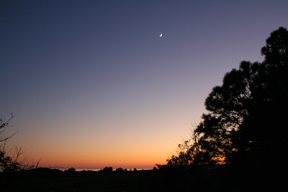


We have had the opportunity to spend an entire week at the beach for Thanksgiving. we have spent the time relaxing: reading, playing cards, running, swimming, going to the movies, walking on the beach, hiking on Pinckney Island, eating, baking, observing wildlife, and shopping. There has been no pressure to do anything. It has been absolutely wonderful. H read 3 books. T read 7. The girls have played cards, cooked, read, watched TV. Mostly, they have laughed. It is wonderful to hear children laugh. It is absolutely contagious. At one point, all 6 of us were laughing so hard that some of us were to the point of tears. The funny thing is that we can't even remember what was making us laugh! It seems the girls started laughing and soon we were all laughing. We could use more laughter in this world! Every day the paper is full of stories of war, suffering, accidents, disasters, man-made problems, violence and corruption. Where are the stories that make us laugh?
This week, we we are thankful for laughter. We are also thankful for: life, sports, family, health, happiness, friends, happy memories of Thanksgivings past, books, flowers, birds, lichen, music, travel, soccer, swimming, passion, a Congress and Senate full of democrats, food, transportation, doctors, teachers, artists, musicians, and homeschooling. We are very lucky to have so much to be thankful for!
Subscribe to:
Posts (Atom)
